Why Quadriceps Activation Matters After ACL Surgery 

Understanding quadriceps inhibition and how NMES can support rehabilitation

Recovering from ACL reconstruction (ACLR) involves more than healing the ligament itself. One of the most important, and often overlooked, aspects of successful knee rehabilitation is restoring quadriceps strength and activation
 
The quadriceps muscle group plays a key role in knee stability, walking mechanics, shock absorption, and safe progression towards return to sport. Following ACL surgery, many people benefit from physiotherapy-led ACL rehabilitation to restore quadriceps strength, improve movement patterns, and progress safely through recovery. 

What is quadriceps inhibition after ACL surgery?

After ACL reconstruction, it is very common to experience quadriceps inhibition, clinically referred to as Arthrogenic Muscle Inhibition (AMI)
 
AMI is a neurological reflex where the nervous system reduces the ability to fully activate the quadriceps muscle in response to factors such as: 
  • Pain 
  • Joint swelling 
  • Inflammation 
  • Disrupted joint signalling following surgery
 
Research shows this protective response can significantly limit voluntary quadriceps contraction, even when someone is actively trying to engage the muscle (Moiroux-Sahraoui et al., 2024).
 
While AMI is most pronounced in the early post-operative period, studies demonstrate it can persist throughout rehabilitation, including during later stages when individuals are preparing to return to sport. 

Why persistent quadriceps weakness matters

If quadriceps inhibition is not adequately addressed, it may contribute to: 
  • Reduced knee strength and stability 
  • Altered walking or running patterns 
  • Muscle wastage (atrophy) 
  • Ongoing knee pain 
  • Delayed rehabilitation progression 
  • Increased risk of re-injury 
  • Long-term joint issues, including osteoarthritis
 
Persistent quadriceps weakness has also been linked to poorer functional outcomes following ACL injury and reconstruction, highlighting the importance of early and ongoing intervention (Moiroux-Sahraoui et al., 2024)

How physiotherapy supports quadriceps activation 

Physiotherapy plays a central role in addressing quadriceps inhibition after ACL surgery. Individualised, evidence-based rehabilitation guided by a physiotherapist focuses on restoring muscle activation, strength, and movement quality while respecting tissue healing timelines. 
 
Treatment strategies may include: 
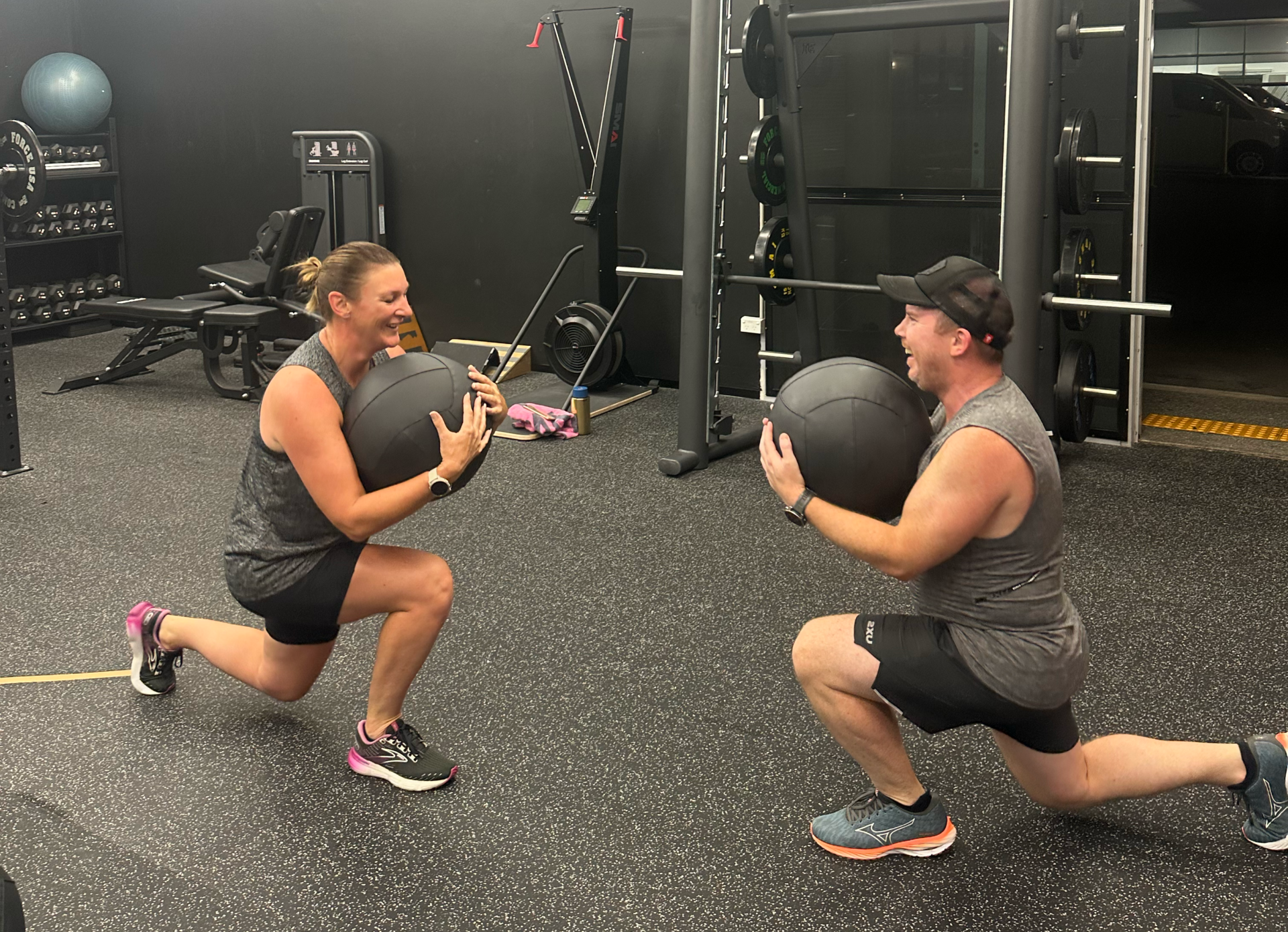
  • Targeted quadriceps activation exercises (e.g. static quads) 
  • Swelling and pain management strategies 
  • Progressive strengthening programs 
  • Movement retraining 
  • Education around load management and recovery 
 
In cases where voluntary quadriceps activation is significantly reduced, adjunct modalities may be used alongside exercise-based rehabilitation to support muscle re-education. 

What is Neuromuscular Electrical Stimulation (NMES)? 

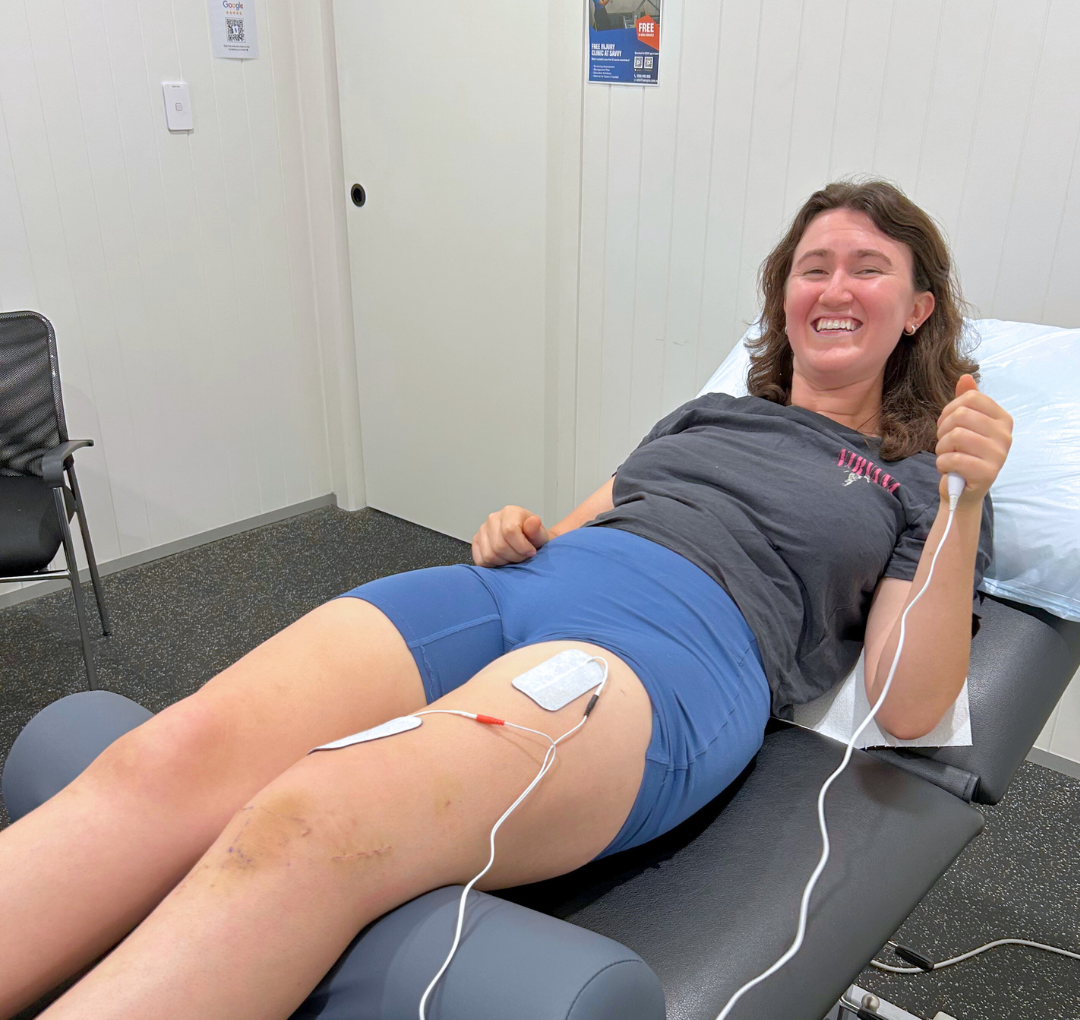
Neuromuscular Electrical Stimulation (NMES) is a therapeutic modality used to assist muscle activation when voluntary contraction is impaired, such as after surgery or injury. 
 
NMES delivers controlled electrical impulses via surface electrodes placed over the quadriceps muscle. These impulses stimulate the motor nerves, causing the muscle to contract involuntarily. 
 
NMES does not replace exercise, but instead supports rehabilitation by: 
  • Improving early quadriceps activation 
  • Reducing the impact of neurological inhibition 
  • Allowing more effective participation in strengthening exercises 

How NMES helps overcome quadriceps inhibition 

Quadriceps inhibition is driven by the nervous system’s protective response to joint trauma. NMES can assist by bypassing this inhibitory pathway, directly stimulating the muscle to contract even when voluntary activation is limited. 
 
When combined with a structured physiotherapy program, NMES has been shown to: 
  • Improve quadriceps activation 
  • Increase muscle strength 
  • Support functional recovery following ACL reconstruction 

What does the evidence say? 

The evidence supporting NMES use after ACL reconstruction is strong. 
 
The Clinical Practice Guidelines for ACL rehabilitation rate NMES as a Grade A, evidence-based intervention when used alongside exercise therapy (Arhos et al., 2024).
 
A systematic review examining NMES following ACL reconstruction found that individuals who used NMES in combination with standard rehabilitation achieved significantly greater improvements in quadriceps strength compared to rehabilitation alone (Li et al., 2025).
 
More recent research continues to support these findings, with studies demonstrating approximately 10–25% greater improvements in quadriceps strength when NMES is appropriately integrated into rehabilitation programs (Li et al., 2025).

Is NMES appropriate for everyone after ACL surgery? 

NMES is not required for every individual and should always be prescribed based on clinical assessment. A physiotherapist can determine whether NMES is appropriate based on factors such as: 
  • Stage of rehabilitation 
  • Degree of quadriceps inhibition 
  • Pain and swelling levels 
  • Functional goals and activity demands 
 
Like all rehabilitation tools, NMES is most effective when tailored to the individual and incorporated into a comprehensive, progressive rehabilitation plan. 

Key takeaway 

Quadriceps strength and activation are critical components of recovery following ACL surgery. Arthrogenic muscle inhibition is common and can persist if not addressed effectively. 
 
Evidence-based physiotherapy, including targeted exercise and, where appropriate, the use of NMES, can support quadriceps activation, strength development, and functional recovery. 
 
If you’ve had ACL surgery and feel your quadriceps aren’t engaging as they should, a physiotherapy assessment can help identify contributing factors and guide appropriate rehabilitation strategies. 

Need support with ACL rehabilitation? 

Our physiotherapists provide individualised, evidence-based rehabilitation following ACL surgery. If you’re experiencing ongoing quadriceps weakness or difficulty progressing your rehab, a physiotherapy assessment can help guide the next steps. 

References

Arhos EK, Ito N, Hunter-Giordano A, Nolan TP, Snyder-Mackler L, Silbernagel KG. Who’s Afraid of Electrical Stimulation? Let’s Revisit the Application of NMES at the Knee. Journal of Orthopaedic & Sports Physical Therapy, 2024.
https://doi.org/10.2519/jospt.2023.12028 

Toth MJ, Tourville TW, Voigt TB, Choquette RH, Anair BM, Falcone MJ, Failla MJ, Stevens-Lapslaey JE, Endres NK, Slauterbeck JR, Beynnon BD. Utility of Neuromuscular Electrical Stimulation to Preserve Quadriceps Muscle Fiber Size and Contractility After Anterior Cruciate Ligament Injuries and Reconstruction: A Randomized, Sham-Controlled, Blinded Trial. American Journal of Sports Medicine, 2020.
https://doi.org/10.1177/0363546520933622

Li Z, Jin L, Chen Z, Shang Z, Geng Y, Tian S, Dong J. Effects of Neuromuscular Electrical Stimulation on Quadriceps Femoris Muscle Strength and Knee Joint Function in Patients After ACL Surgery: A Systematic Review and Meta-analysis of Randomized Controlled Trials. Orthopaedic Journal of Sports Medicine, 2025.
https://doi.org/10.1177/23259671241275071

Moiroux-Sahraoui A, Forelli F, Mazeas J, Rambaud AJ, Bjerregaard A, Riera J. Quadriceps Activation After Anterior Cruciate Ligament Reconstruction: The Early Bird Gets the Worm! International Journal of Sports Physical Therapy, 2024.
https://doi.org/10.26603/001c.121423

Picture of Bridget Shirlow

Bridget Shirlow

Physiotherapist

Share this post:

Facebook
Pinterest
LinkedIn
On Topic

Related Posts

Student Placement at SAVVY

Fill in the form below to enquire about Student Placements at SAVVY. Once submitted, someone from our team will be in touch to talk about your options. 

Personal Training at SAVVY

Fill in the form below to enquire about Personal Training at SAVVY. Once submitted, someone from our team will be in touch to talk about your options.